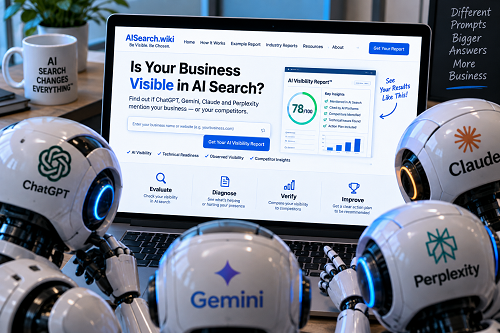
AI Search Visibility • ChatGPT, Google AI, Perplexity AI, Copilot, Claude, Grok

AI Search Visibility: See Whether AI Finds, Cites & Recommends Your Business

Evaluate → Diagnose → Verify™ AISearch.wiki uses a three-step visibility workflow: First → Evaluate whether your page has strong AI visibility potential, Second → Diagnose whether technical search-readiness issues could hold it back, Then → Perform the final observed check to see whether your brand actually appears—and which competitors appear instead.

Visibility potential Entity clarity Source strength AI readiness Observed mentions Competitor share of voice
01 · Evaluate

How strong is your AI visibility potential?

Evaluate discoverability, entities, evidence, answer extractability, trust and freshness.

02 · Diagnose

Is your site technically ready for AI search?

Inspect crawlability, indexing, canonicalization, structured data and crawlable content.

03 · Verify · Final Check

Do you actually appear in AI Search—and who appears instead?

Run defined prompts, capture mentions and citations, and compare tracked competitors.

The AISearch.wiki 3-step diagnostic

Start with AI Search potential. Check your Search readiness. Finish with observed AI Search reality.

Each checker answers a different question. Use them in sequence so the final observed result has context: first determine whether the page appears citation-worthy, then find technical blockers, then verify what AI answer systems actually return.

01 · Evaluate

AI Visibility Potential Checker

Question: Should this page have strong potential to appear and be cited?

Inspect public signals that can make a page easier to discover, understand, trust and use as a source. This diagnostic measures potential—not current proprietary AI results.

  • Discoverability
  • Entity strength
  • Citation/source strength
  • Answer extractability
  • Trust and freshness
AI Search Visibility

1. CHECK VISIBILITY POTENTIAL →
02 · Diagnose

AI Search Readiness Checker

Question: Is anything technical preventing stronger AI-search visibility?

Audit the technical and on-page foundation that search and AI systems need before they can reliably reach, index and interpret a public page.

  • HTTP/HTTPS and indexability
  • Canonical and sitemap discovery
  • Search/AI crawler access
  • Headings and crawlable text
  • Structured data and authorship
AI Search Readiness

2. CHECK SEARCH READINESS →
03 · Final check

Observed AI Visibility + Competitor Comparison

Question: After evaluating and diagnosing the site, does your brand actually appear—and who appears instead?

Run a defined prompt set across configured providers, distinguish mentions from domain citations, and compare the same observations against tracked competitors.

  • Brand mention rate
  • Domain citation rate
  • Observed prompt coverage
  • Competitor share of voice
  • Provider-by-provider results
  • Baseline and monitoring-ready history
3. RUN FINAL VISIBILITY CHECK →

Get Your Personalized AI Visibility 2k27 Report
Published AISearch.wiki evidence

What does AI visibility look like in a real market?

AISearch.wiki evaluated 40 prominent Miami personal injury law firms using its 100-point AI Visibility Potential framework. The September 2026 benchmark found strong overall discoverability—but a much larger gap in citation-ready evidence.

Miami Personal Injury Lawyers
77.2/100
40 firms
Miami, Florida
September 6, 2026
Median visibility score 77/100
Strong firms · 80–89 17
Excellent firms · 90+ 0
Average Citation Strength 10.7/20

Headline finding: Miami firms were generally highly discoverable, averaging 23.1/25 for Discoverability, but substantially weaker at publishing citation-ready evidence. No firm in the 40-firm cohort reached the 90+ Excellent tier.

Miami benchmark · leading firms
Mausner Group Injury Lawyers
89
Goldberg & Rosen
88
Needle & Ellenberg, P.A.
88
Perkins Personal Injury Lawyers
87

These scores measure observable public website and source signals—not legal quality and not current proprietary AI-platform ranking positions. Actual mentions and citations should be measured separately with defined prompts using the Observed AI Visibility Checker.

VIEW THE MIAMI RESEARCH → DOWNLOAD THE DATA →
Measure the right thing

Three different questions. Three different measurements.

MeasurementQuestionMethodBest use
01 · AI Visibility Potential Does this page contain strong signals for understanding, trust and citation-worthiness? Evaluate discoverability, entities, evidence, answer structure and trust signals. Establish the page's visibility potential and prioritize improvements.
02 · AI Search Readiness Can search and AI systems technically reach and interpret this page? Inspect the public webpage and discovery controls. Find crawl, index, canonical, schema and structural blockers.
03 · Observed AI Visibility Does the brand or domain actually appear for the prompts being tested? Observe returned answers and sources across configured providers. Measure mentions, citations, prompt coverage and changes over time.
03B · Competitor Comparison Who surfaces more often for the same prompt set? Compare tracked brands under the same observation framework. Identify visibility gaps and competitive opportunities.
The diagnostic sequence

Evaluate → Diagnose → Verify.

The first two tools explain the site's potential and technical foundation. The third tool is the final reality check: whether the target actually surfaces for the prompts being tested.

01 · Evaluate

Visibility Potential

Measure entity clarity, evidence, answer structure, discoverability, trust and freshness.

02 · Diagnose

Search Readiness

Find crawl, indexing, canonical, crawler-access, schema and structural obstacles.

03 · Verify

Observed Visibility

Run the final check: measure actual mentions, citations, prompt coverage and competitor share of voice.

After the final check

Monitor → Improve → Recheck.

Once the observed checker establishes a baseline, recurring monitoring becomes the subscription value: track visibility changes, identify competitor gains, improve the underlying site, and rerun the same prompt framework to measure what changed.

AI Search Optimization Guide

Build pages that can be discovered, understood, trusted and used.

AI-search optimization starts with ordinary search fundamentals, then adds clearer entities, stronger evidence, self-contained answers and measurement of what actually surfaces.

1. Make important pages discoverable

AI-search visibility begins with a page that can be crawled, indexed and understood as part of the broader web. Fix ordinary technical-search problems before searching for an AI-only shortcut.

Use stable HTTPS URLs, valid status codes, deliberate robots directives, useful internal links and canonical signals. Google states that the same foundational SEO practices remain relevant to AI Overviews and AI Mode and that there are no special additional technical requirements solely for those features.

2. Make the subject and entities unambiguous

A strong page makes it obvious who or what it is about, how named entities relate to each other, and which organization or author is responsible for the information.

Use descriptive titles and headings, consistent brand naming, accurate structured data that matches visible content, authorship where appropriate, and supporting identity pages. Structured data can improve machine understanding, but it is not an AI-ranking switch.

3. Give claims evidence

Citation-worthy content should make important claims inspectable. Show the source, methodology, date, first-hand test, original dataset or other basis when the claim needs evidence.

Original analysis and primary evidence give a page a reason to be used instead of merely paraphrased. For time-sensitive facts, show when the information was checked and update it when conditions change.

4. Write complete answer passages

Put a direct answer near the beginning of an important section, then support it with detail, examples, comparisons and evidence.

Question-oriented headings, readable tables, lists and self-contained paragraphs make content easier for people to scan and easier for retrieval systems to interpret. Avoid hiding key information only inside images or client-side interactions.

5. Measure what actually surfaces

Readiness and page quality are not the same as observed visibility. Test defined prompts and record which brands, domains and sources actually appear.

Keep the prompt set stable when comparing changes. Note the provider, time and any location assumptions. Observed AI answers are variable, so one result should not be treated as a permanent universal ranking.

6. Diagnose the gap and retest

When a competitor appears and you do not, use the gap as a research question: what source, entity, content, authority or technical difference could explain the observation?

Strengthen the underlying page, publish genuinely useful evidence, improve internal discovery and retest the same prompt set. Track meaningful changes rather than optimizing for a single screenshot.

Where AI visibility matters

Measure across the AI-search ecosystem.

Different products can select different sources for the same question. Treat each system as its own observation surface rather than assuming one result represents every AI answer product.

Google AIAI Overviews, AI Mode and the broader Google Search ecosystem.
ChatGPT SearchWeb discovery, source links and cited answers when search is used.
PerplexityAnswer-oriented web retrieval with surfaced sources and citations.
Other AI answer systemsAdditional providers can differ in retrieval, ranking, geography and citation behavior.
Frequently asked questions

AI visibility and competitor comparison FAQ

What is observed AI visibility?

Observed AI visibility measures whether a brand or domain actually appears, is mentioned or is cited for a defined set of prompts at a defined time. It is evidence from an observation, not a permanent ranking.

How does the competitor comparison work?

The checker applies the same prompt set and observation rules to your target and tracked competitors, then compares mentions, citations, prompt coverage and approximate share of voice. This helps reveal who is surfacing more often for the same questions.

What is the difference between Visibility Potential and Observed Visibility?

Visibility Potential inspects public website signals such as entities, sources, answer structure and trust. Observed Visibility checks returned AI answers and sources to see whether the brand actually surfaced for defined prompts.

What is AI Search Readiness?

AI Search Readiness is the technical foundation: crawlability, indexability, canonicalization, readable HTML, structured data and related signals that help search and AI systems reach and interpret a page.

Does a high score guarantee ChatGPT, Google AI or Perplexity will cite my site?

No. Search and AI platforms use proprietary systems, and results can vary by query, provider, locale, personalization, time and available sources. AISearch.wiki scores and observations are diagnostic evidence, not guarantees.

Does llms.txt make a site rank in AI search?

No guaranteed ranking effect should be assumed. Treat llms.txt as an optional publishing and discovery convention. Crawlability, indexing, useful content, strong entities, evidence and ordinary SEO fundamentals remain more important.

How can a site be discoverable in ChatGPT Search?

OpenAI states that publishers should allow OAI-SearchBot if they want site content to be discoverable for ChatGPT search summaries and citations. Crawler access is only one prerequisite; it does not guarantee selection.

Primary guidance used by AISearch.wiki

Last updated: September 9, 2026. AISearch.wiki distinguishes observable website diagnostics from actual platform observations and does not claim to reverse-engineer proprietary ranking systems.